11 Best Seeking Alpha Alternatives in 2026
Top stock research platforms beyond Seeking Alpha
Morningstar is the best Seeking Alpha alternative for analyst-written research, while TIKR is better for detailed financial data, Koyfin for screening and charts, and Stock Analysis for a completely free option. The right replacement depends on whether you want to replace Seeking Alpha's articles, Quant Ratings, screening tools, or company data.
We've tested and compared 11 platforms that offer stock research capabilities — from free tools with comprehensive financial data to premium platforms with professional-grade analysis and screening tools. Each recommendation below is based on actual usage, not affiliate deals.
If it's Seeking Alpha's written research you'll miss most, our investment newsletter directory and hedge fund letters archive are strong complements to the data platforms below.
Quick answer
What is the best Seeking Alpha alternative?
Morningstar is the best Seeking Alpha alternative for analyst-led fundamental research. Choose TIKR for detailed global financial data or Koyfin for customizable screening and charts. Fiscal.ai is strongest for company-specific KPIs and AI-assisted research, while Stock Analysis is the best completely free option.
Best overall research
Morningstar
Analyst reports, fair values, and moat ratings.
Best for financial data
TIKR
Deep global statements, estimates, and valuation tools.
Best for screening
Koyfin
Flexible screens, dashboards, and market charts.
Best for KPIs and AI
Fiscal.ai
Company-specific operating metrics with AI-assisted research.
Best completely free
Stock Analysis
Clean financial statements, estimates, and earnings data.
Best visual research
Simply Wall St
Accessible visual summaries and global stock coverage.
Best written stock picks
Motley Fool
Curated recommendations with supporting research.
Choose a Seeking Alpha Alternative by What You Want to Replace
Replace: Written analyst research
Choose Morningstar
Professional analyst reports, fair values, and moat ratings.
Replace: Quant Ratings and stock scores
Choose TipRanks
Analyst-performance data and a multi-factor Smart Score.
Replace: Stock screening and charts
Choose Koyfin
Custom screens, dashboards, comparisons, and market charts.
Replace: Detailed company financials
Choose TIKR
Global statements, estimates, valuation data, and transcripts.
Replace: Company KPIs and AI research
Choose Fiscal.ai
Segment data, operating metrics, filings, and AI-assisted analysis.
Replace: A completely free option
Choose Stock Analysis
Clean financial statements, estimates, earnings, and market data.
Seeking Alpha Alternatives Compared
| Platform | Best For | Pricing |
|---|---|---|
| Morningstar | Fundamental analysis and fund research | Investor $34.95/month or $249/year |
| TIKR | Institutional-grade financial data at consumer prices | Free; Plus $24.95/month |
| Koyfin | Advanced charting and screening | Free; Plus $39/month |
| Fiscal.ai | Company KPIs, financial data, and AI-assisted research | 7-day free trial; paid pricing shown at signup |
| Motley Fool Stock Advisor | Beginner stock picks | From $99/year |
| WallStreetZen | Quick stock health checks | Free tier; Premium from $19.99/month |
| GuruFocus | Value investing analysis | Limited free access; US Premium $549/year |
| Stock Analysis | Best free alternative for basic research | Free; Pro $9.99/month or $79/year |
| TipRanks | Analyst consensus ratings | Free tier; Premium from $29.95/month |
| Yahoo Finance | Best free general-purpose option | Free; Plus from $49.99/year |
| Simply Wall St | Visual stock analysis | Free; Premium and Unlimited plans available |
Top Picks
Morningstar
Fundamental analysis and fund research
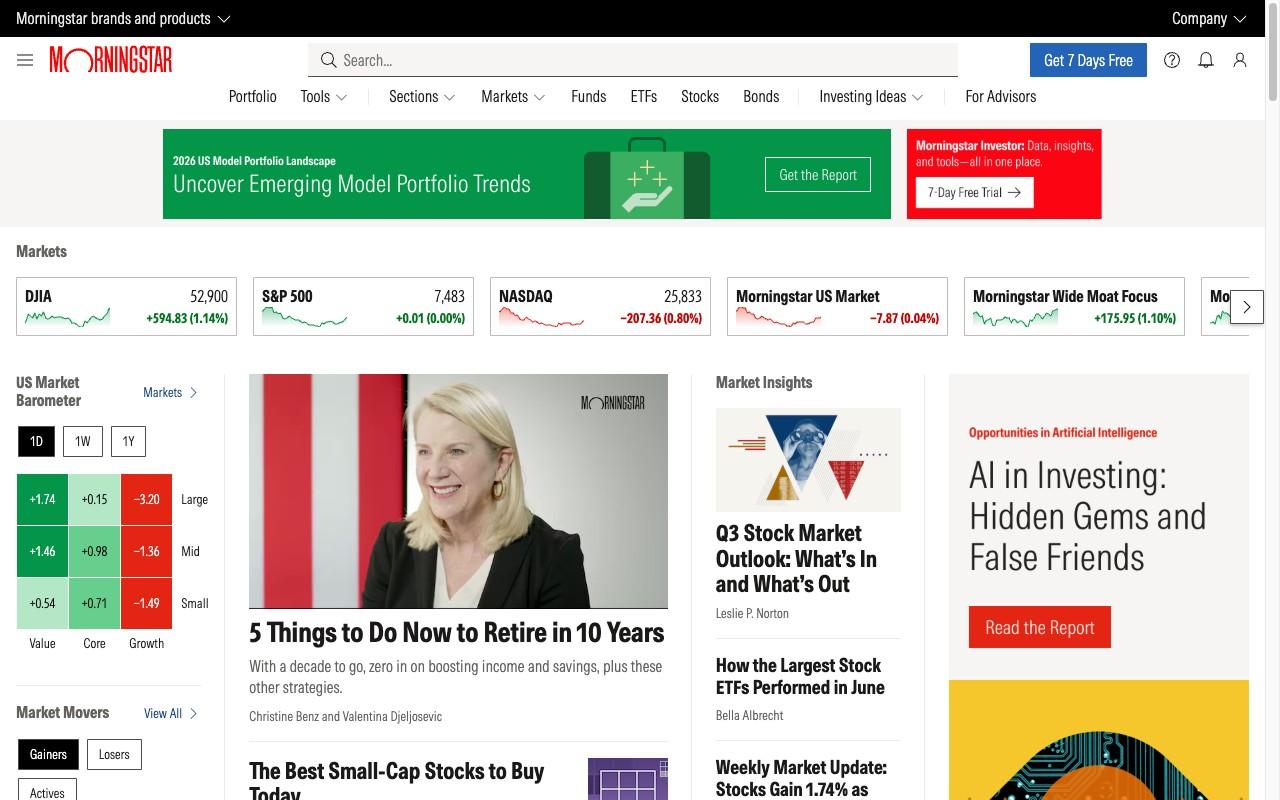
Morningstar is the gold standard for fundamental analysis and mutual fund research. Their analyst reports go deep on company moats, fair value estimates, and stewardship grades — areas where Seeking Alpha relies on crowdsourced opinions. Morningstar's proprietary star rating system and economic moat analysis give investors a structured, institutional-grade framework for evaluating stocks and funds, backed by decades of trusted, independent research history that predates most crowdsourced platforms. Some public quotes and editorial content remain available, while Morningstar Investor starts at $34.95/month for full analyst reports — pricier than most alternatives on this list, and a real tradeoff if you're used to Seeking Alpha's lower-cost Premium tier. What you give up in price you gain in mutual fund and ETF research, an area where Morningstar remains best-in-class; the one thing you won't find here is Seeking Alpha's community discussion and comment threads, since Morningstar's research comes entirely from in-house analysts rather than crowdsourced contributors.
Pros
- +Institutional-quality analyst reports with fair value estimates
- +Best-in-class mutual fund and ETF research tools
- +Proprietary economic moat and stewardship ratings
- +Decades of trusted, independent research history
Cons
- -Premium pricing is higher than most competitors
- -Less community discussion compared to Seeking Alpha
TIKR
Institutional-grade financial data at consumer prices
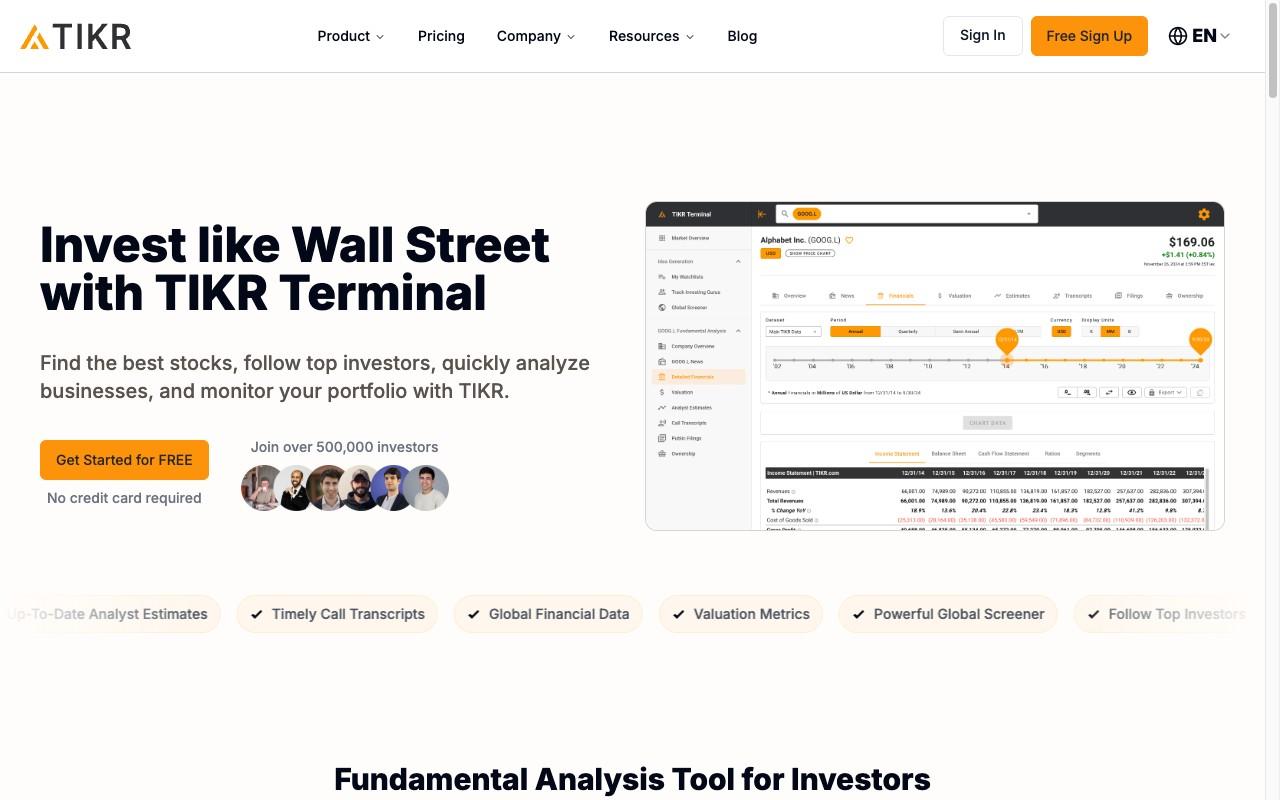
TIKR Terminal brings Bloomberg-style financial data to retail investors at a fraction of the cost. It offers 10+ years of detailed financial statements, analyst estimates, and valuation metrics for over 100,000 global stocks, wrapped in a clean interface built for serious fundamental analysis rather than casual browsing. Where Seeking Alpha focuses on articles and opinion, TIKR focuses on raw data — making it the better choice for investors who prefer building their own models and doing their own analysis. A free tier is available, and the Plus plan starts at just $24.95/month, comprehensive analyst estimates and consensus data included. The tradeoff is that TIKR has no editorial content or community discussion features at all — you won't find crowdsourced investment theses or comment sections here — and the terminal-style interface carries a steeper learning curve for investors who are newer to financial statement analysis.
Pros
- +10+ years of detailed financial data for global stocks
- +Bloomberg-like terminal experience at retail pricing
- +Comprehensive analyst estimates and consensus data
- +Clean interface designed for serious fundamental analysis
Cons
- -No editorial content or community discussion features
- -Steeper learning curve for casual investors
Koyfin
Advanced charting and screening
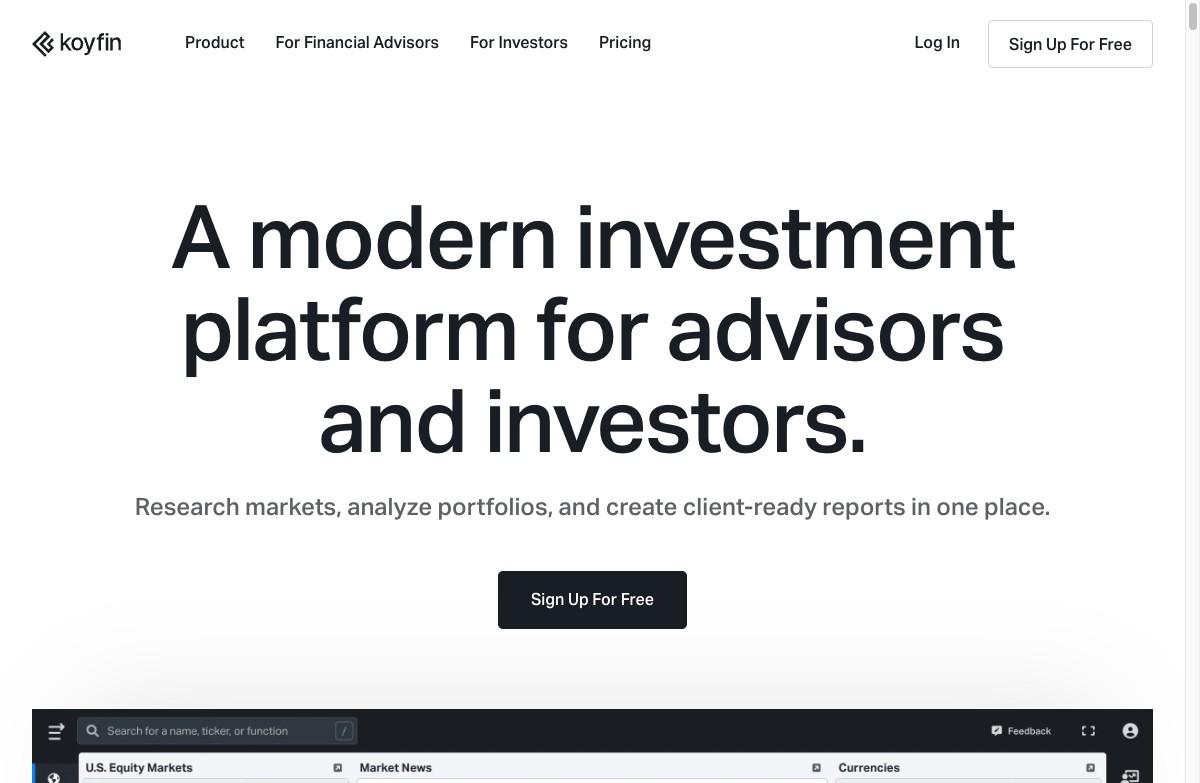
Koyfin is a powerful financial data and charting platform that rivals expensive institutional tools like Bloomberg terminals, at a fraction of the price. It excels at advanced screening, custom dashboards, and multi-company comparisons — features that Seeking Alpha's article-first interface doesn't prioritize. Koyfin's free tier is remarkably generous, offering access to financial data, news feeds, macro and economic data, and basic charting that covers what most retail investors actually need day to day. Upgrading to Plus (from $39/month) unlocks deeper screening and dashboard customization for investors who want to track multiple metrics across a watchlist. What you won't find on Koyfin is any analyst articles or crowdsourced investment theses — it's a pure data and charting tool, not a research-article platform — and the more advanced screening features do require that paid subscription rather than being available for free.
Pros
- +Exceptionally powerful charting and screening tools
- +Custom dashboards for tracking multiple metrics
- +Generous free tier covers most basic research needs
- +Macro and economic data alongside equity research
Cons
- -No analyst articles or crowdsourced investment theses
- -Advanced features require a paid subscription
More Seeking Alpha Alternatives
Fiscal.ai
Company KPIs, financial data, and AI-assisted research
Fiscal.ai, formerly FinChat, is a fundamental-research platform built around global financial statements, company-specific segment and KPI data, estimates, filings, dashboards, and AI-assisted analysis. It is a particularly useful Seeking Alpha alternative for investors who care more about interrogating company data and operating drivers than reading crowdsourced opinion articles. A seven-day trial provides an entry point before subscribing. Its limitations are the reverse of Seeking Alpha's strengths: Fiscal.ai does not recreate a large contributor community, and the depth of its data-oriented interface can take time to learn.
Pros
- +Company-specific segment and KPI data
- +Financial statements, estimates, filings, and dashboards in one workflow
- +AI-assisted research grounded in financial data
- +Free plan available for testing the platform
Cons
- -No large crowdsourced article community
- -Data-heavy interface has a learning curve
Motley Fool Stock Advisor
Beginner stock picks
Motley Fool Stock Advisor is one of the longest-running stock picking services, delivering two new stock recommendations per month along with detailed research reports explaining the investment thesis behind each pick. Unlike Seeking Alpha's open contributor model, Motley Fool's picks come from a curated internal team with a publicly tracked, long-term performance record — useful if you want conviction-driven ideas rather than sifting through thousands of competing opinions yourself. Membership runs about $99/year, and includes access to community forums where members discuss the current picks with each other and the Motley Fool team. The tradeoff is that recommendations skew heavily toward growth stocks rather than value or income plays, and the service offers limited fundamental data or screening tools of its own — Stock Advisor is built around curated picks, not a self-serve research platform, so it suits beginners who want direct guidance more than hands-on analysis.
Pros
- +Curated stock picks with a long-term track record
- +Simple, beginner-friendly research reports
- +Two new recommendations every month
- +Community forums for discussing picks with other members
Cons
- -Recommendations skew heavily toward growth stocks
- -Limited fundamental data and screening tools
WallStreetZen
Quick stock health checks
WallStreetZen simplifies stock research into quick, digestible health checks rather than long-form analysis. Each stock gets a Zen Score based on valuation, financials, forecasts, and performance — giving you a fast read on whether it's worth digging deeper, plus guru portfolio tracking that shows what top investors currently own. Where Seeking Alpha can overwhelm with hundreds of articles per stock, WallStreetZen distills the key metrics into a clean, visual summary that takes minutes instead of hours, which is what earns it a spot as a quick due-diligence tool rather than a deep-research one. A free tier is available, with Premium starting at $19.99/month for the full Zen Score breakdown. The main tradeoffs: WallStreetZen offers less depth than platforms built around full financial statements, and it's a comparatively newer platform with a smaller user base than the more established names on this list, so its track record is shorter.
Pros
- +Zen Score provides an instant stock health snapshot
- +Clean, visual interface that simplifies complex data
- +Guru portfolio tracking shows what top investors own
- +Quick due diligence without information overload
Cons
- -Less depth than platforms with full financial statements
- -Relatively newer platform with a smaller user base
GuruFocus
Value investing analysis
GuruFocus is built for value investors who want deep fundamental analysis paired with guru portfolio tracking. It provides proprietary valuation models including DCF calculators, the Graham Number, and a financial strength score that goes far beyond what Seeking Alpha offers on its stock pages, plus 30+ years of historical financial data useful for backtesting investment ideas. GuruFocus also tracks the portfolios of over 60 renowned investors via 13F filings, adding a unique social-proof layer most competitors don't offer, and its screener includes value-oriented filters built specifically for Graham- and Buffett-style investing. The catch is cost: limited free access gives way to a Premium plan starting at $449/year, one of the highest prices in this category, and the dense data-heavy interface can feel overwhelming compared to more visually simplified competitors like WallStreetZen or Simply Wall St — this is a tool built for investors who want maximum data depth and are willing to pay and learn the interface for it.
Pros
- +Built-in DCF and valuation models for every stock
- +Tracks 60+ superinvestor portfolios via 13F filings
- +Comprehensive screener with value-oriented filters
- +30+ years of financial data for backtesting ideas
Cons
- -Premium pricing is one of the highest in the category
- -Interface can feel overwhelming with dense data layouts
Stock Analysis
Best free alternative for basic research
Stock Analysis (stockanalysis.com) has quickly become one of the best free stock research platforms available. It provides financial statements, analyst estimates, earnings data, and IPO tracking in a clean, fast interface with no clutter — the generous free tier covers all of this, with a Premium plan starting at just $9.99/month, the most affordable premium tier among the platforms on this list. For investors who used Seeking Alpha primarily for quick access to financial data and earnings information rather than its crowdsourced articles, Stock Analysis delivers most of that core functionality completely free, plus an IPO calendar most competitors don't offer at no cost. What it doesn't replicate is Seeking Alpha's editorial ecosystem: there's no investment thesis content or contributor articles here, and its screening tools are noticeably less advanced than what paid platforms like Koyfin or TIKR Terminal provide, so it works best as a data reference rather than a screening tool.
Pros
- +Generous free tier covers financial statements and estimates
- +Exceptionally clean and fast user interface
- +IPO calendar and earnings tracking included free
- +Most affordable premium tier among competitors
Cons
- -No editorial content or investment thesis articles
- -Screening tools are less advanced than paid platforms
TipRanks
Analyst consensus ratings
TipRanks stands out by tracking and ranking the accuracy of Wall Street analysts, financial bloggers, and corporate insiders, rather than just aggregating their opinions. Its Smart Score combines eight different signals — including analyst accuracy, insider activity, and hedge fund positioning — into a single stock rating, cutting through the noise that can plague open, crowdsourced platforms like Seeking Alpha. TipRanks is particularly valuable for investors who want to know which analysts actually have strong track records before trusting their price targets, and its clean interface makes those ratings easy to parse at a glance. A free tier gets you started, but Premium (from $29.95/month) is required to unlock most of the actionable features, including the full Smart Score breakdown and hedge fund tracking. The main limitation is coverage: analyst attention — and therefore TipRanks' data — can be thin for small-cap stocks, so it's most useful for large- and mid-cap names with active analyst followings.
Pros
- +Tracks analyst accuracy so you know who to trust
- +Smart Score combines eight signals into one metric
- +Hedge fund and insider trading activity tracking
- +Clean interface with easy-to-understand ratings
Cons
- -Premium is required for most actionable features
- -Analyst coverage can be thin for small-cap stocks
Yahoo Finance
Best free general-purpose option
Yahoo Finance remains the most widely used free financial platform on the web, and for good reason. It provides real-time quotes, financial statements, analyst estimates, earnings calendars, and portfolio tracking — all without requiring a paid account — plus discussion boards for nearly every stock, giving it a community dimension closer to Seeking Alpha's than most other alternatives on this list. While it lacks the depth of Seeking Alpha's long-form analyst articles and doesn't produce any proprietary research or investment thesis content of its own, Yahoo Finance's breadth of free data and massive user base make it a solid general-purpose alternative for investors who just need reliable numbers and news in one place. A Plus tier is available from $49.99/year for ad-light browsing and extra portfolio tools, since the free tier's biggest tradeoff is a genuinely ad-heavy experience — worth factoring in if a cluttered interface is a dealbreaker for daily use.
Pros
- +Comprehensive free tier with real-time market data
- +Massive community and discussion boards for every stock
- +Portfolio tracking and watchlist tools included free
- +Integrates news from hundreds of financial sources
Cons
- -Ad-heavy experience on the free tier
- -No proprietary research or investment thesis content
Simply Wall St
Visual stock analysis
Simply Wall St transforms complex financial data into visual infographics, most notably its signature snowflake chart that rates stocks across five dimensions — value, future growth, past performance, financial health, and dividends — at a glance. It's designed for visual learners who find traditional data tables and Seeking Alpha's long-form articles intimidating, favoring beautiful visual reports over dense text on every covered stock. With global coverage spanning over 100 markets, Simply Wall St is also one of the best options for investors researching international stocks that Seeking Alpha covers less thoroughly, and it offers a usable free tier alongside paid Premium and Unlimited plans. The tradeoff for that visual simplicity is depth: the snowflake approach can oversimplify some complex metrics, and the platform offers limited depth for advanced fundamental analysis compared to data-heavy tools like TIKR Terminal or GuruFocus — best suited as a first pass, not a final word.
Pros
- +Signature snowflake chart makes analysis intuitive
- +Global coverage across 100+ stock markets
- +Beautiful visual reports for every stock
- +Affordable premium pricing for individual investors
Cons
- -Visual approach oversimplifies some complex metrics
- -Limited depth for advanced fundamental analysis